From Tier 4 to OEM: The world’s first Catena-X PCF pilot across five supply chain tiers
In a pilot project, five South Korean companies, supported by sustainability software provider Glassdome, determined CO2 data for a product chain and exchanged it via Catena-X with the help of Cofinity-X. A comparison of initial estimates and actual primary data led to PCF reductions of up to 18.4 percent. Moreover, data quality, which is as important as the PCF value itself, improved in every case. The results show how standardized calculation methods, primary data, and secure data exchange can support targeted decarbonization in the automotive industry.
Digitizing the automotive value chain
A modern car consists of approximately 30,000 to 100,000 parts. Thousands of companies are involved in the production of a single vehicle, forming complex supply chains. Digitizing these physical chains makes it possible to share and use important information, including sustainability data. How much CO2 is emitted at each specific supply chain tier? What share is attributable to each component? What is the vehicle’s consolidated PCF? And, based on this reliable data foundation, what measures can be taken to reduce the carbon footprint? The Catena-X PCF Use Cases aims to answer these questions. The Catena-X PCF Rulebook defines standardized determination and calculation methods. At the same time, Catena-X provides a secure data exchange infrastructure through which partners can share the results.
The world’s first PCF pilot project across five supply chain tiers
To test the impact of this type of data collaboration, the five South Korean companies LG Chem, Shinsung Autotech, New Material Industry, LG Electronics, and KG Mobility (KGM) joined forces to form a product carbon footprint chain for KGM’s new Musso Q270 pickup truck. In this chain, resin is gradually processed into a button, a panel, and finally an electronic component used in the Q270. For the first time, the pilot demonstrates the exchange of product-related primary CO2 data across a five-tier supply chain, from raw material to vehicle manufacturer.
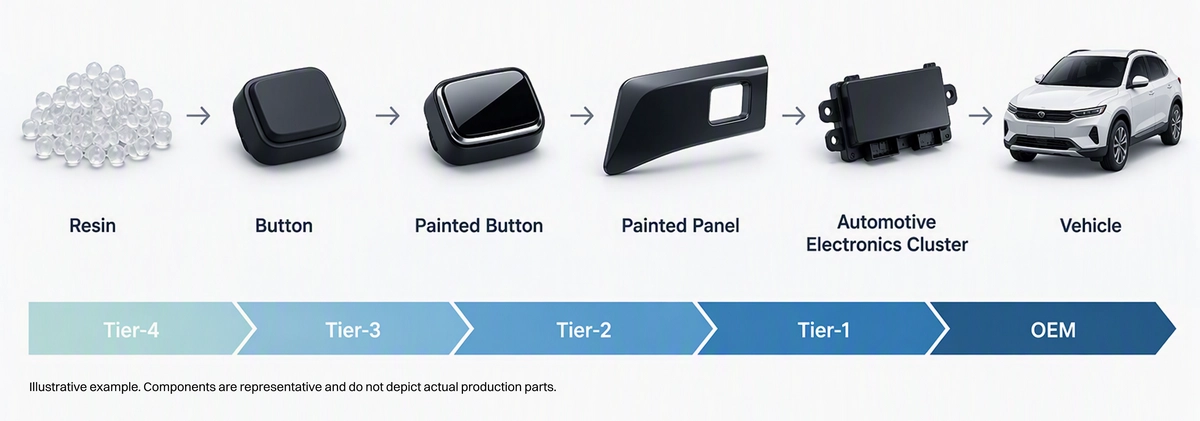
Under Glassdome’s leadership, the participating organizations initially determined the PCFs using estimates and reference values from industry databases for comparable products and materials.
Following this conventional baseline assessment, the companies collected primary activity data on energy use, raw materials, and process inputs from their actual production. They then used Glassdome’s sustainability software to calculate the values in accordance with the Catena-X PCF Rulebook.
Lower PCF values with higher-quality data
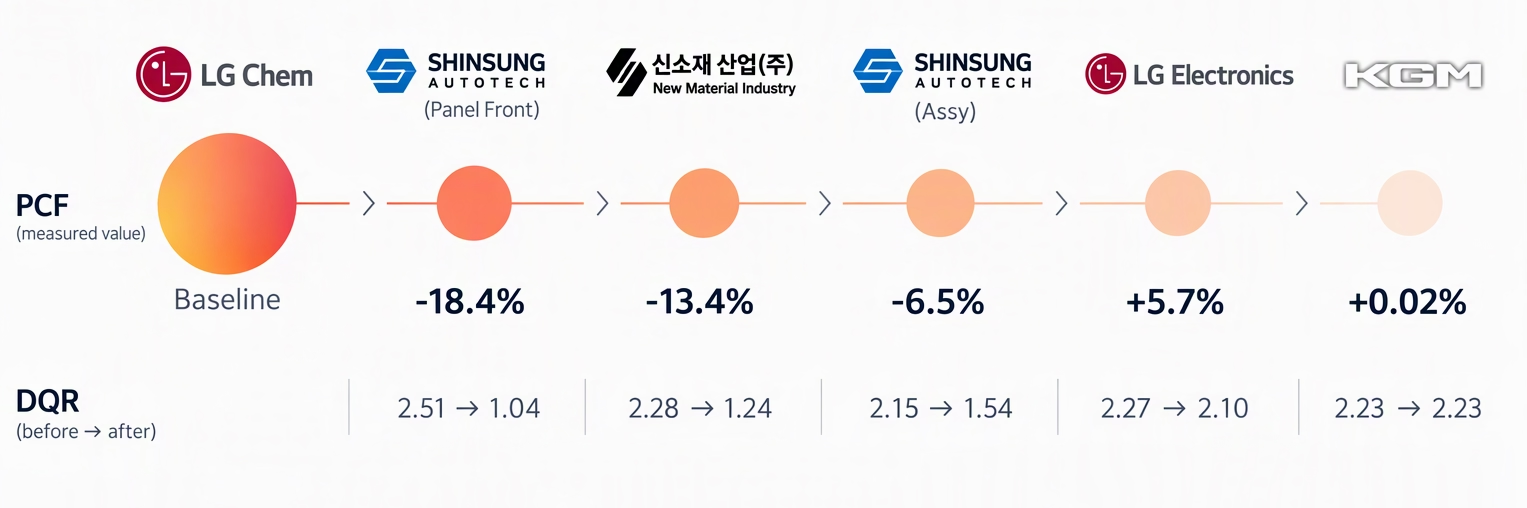
The comparison between the secondary-data-based and primary-data-based processes reveals a PCF reduction of up to 18.4 percent for some of the partners from the raw-material level through the component level. In other words, the values based on primary data were considerably lower than the estimates used previously. This effect diminishes further up the supply chain, as the data measurements account for only a small fraction of the vehicle's total 30,000 to 100,000 parts. However, the Data Quality Rating (DQR) improves across all supply chain tiers. The DQR score is measured on a scale of 1 to 5. The lower the score, the closer the data is to the actual value. This increases the reliability of sustainability data and gives companies a stronger basis for future decarbonization efforts.
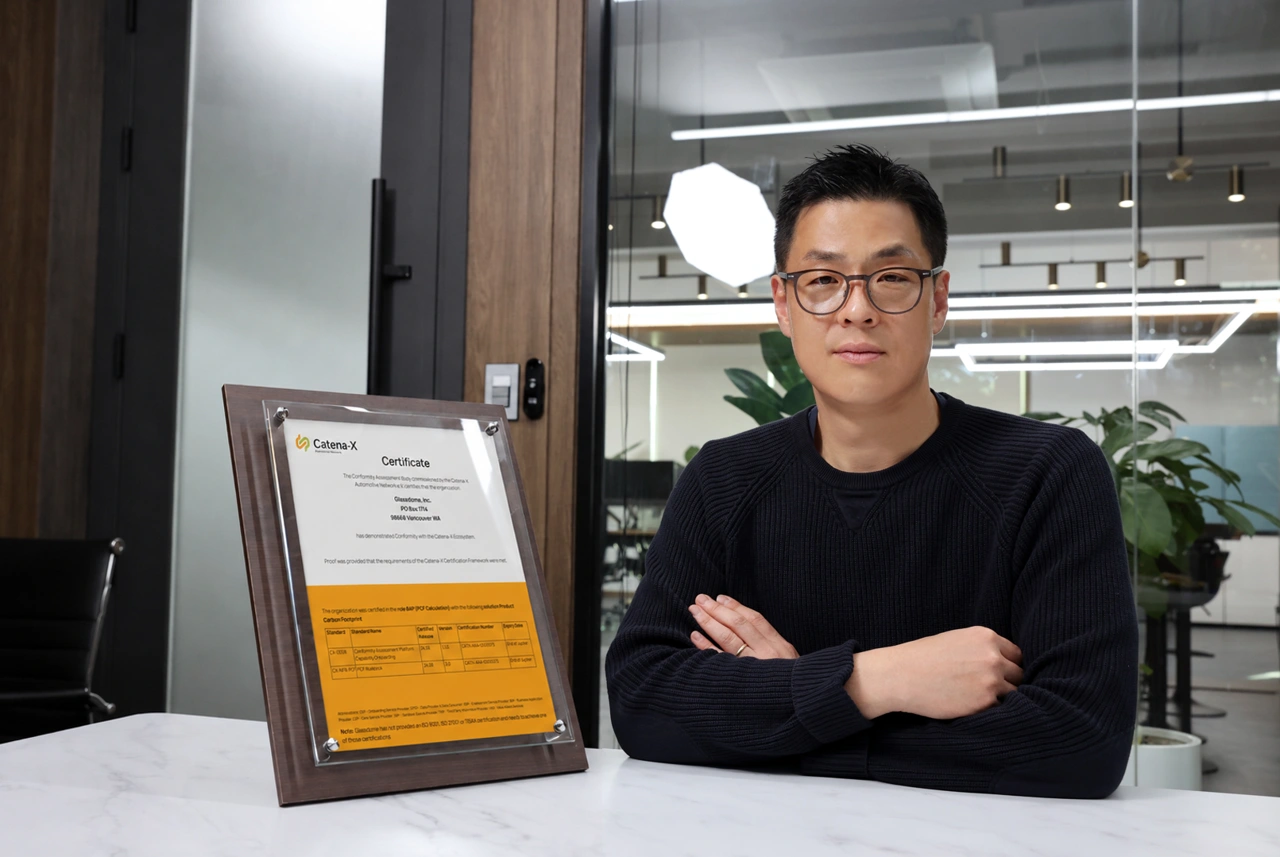
“By combining Glassdome’s platform with dedicated Catena-X connector technology by Cofinity-X, we have enabled end-to-end integration across the supply chain— from data collection to verification. We aim to establish this project as a standard model and support Korean manufacturers in seamlessly integrating into the global carbon data ecosystem.”
Jinki Ham CEO of Glassdome

Secure and sovereign data exchange via Cofinity-X
Besides collecting and calculating precise data, efficient and secure communication channels are becoming increasingly important in the automotive industry so that information can be selectively shared across the entire supply chain. The Catena-X dataspace creates precisely these communication channels through common standards and rules. Cologne-based Cofinity-X operates the technical infrastructure for Catena-X and manages participants’ dataspace licenses and digital identities. For the PCF pilot project, three of the five participants registered through Cofinity-X, one used its existing Cofinity-X license, and another took advantage of the Cofinity-X beta environment. Cofinity-X provided all five participants with the Dataspace OS application. Dataspace OS is an Eclipse Dataspace Components (EDC) Connector, the interface every participant needs for technical connectivity to Catena-X. The app is also certified for the exchange of PCF data, among other use cases. Using Dataspace OS, the data could be transferred step by step from the raw material supplier to the manufacturer, with each participant interacting only with its respective upstream and downstream partner in the chain, thereby reducing the risk of unintentional disclosure of sensitive information.
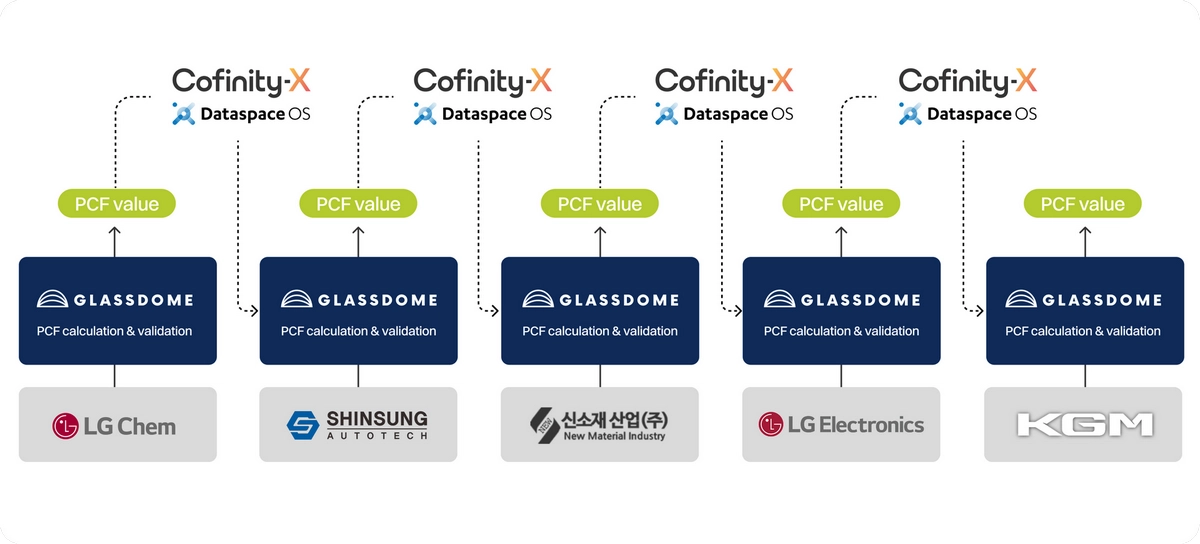
Dataspace OS enables precise documentation of data collaboration, including status updates on requests to and from partners. Even with just a few partners, the pilot shows that data exchange becomes more transparent and traceable than traditional methods like email. The full potential of the Catena-X Use Case can be realized when this process is scaled to the entire vehicle and, over time, to vehicle fleets across multiple manufacturers.
“The South Korean sustainability project demonstrates that companies do not have to choose between collaboration and control. With Dataspace OS, sustainability data can be shared securely across company boundaries while each partner retains full sovereignty of its information."
Thomas Rösch CEO of Cofinity-X

Regulations demand greater supply chain transparency
The importance of this type of data collaboration continues to grow. In the area of sustainability, regulations—particularly, though not exclusively, those from the European Union—are increasing the pressure on the automotive industry. Catena-X can help address this pressure. The South Korean pilot shows how companies can obtain more precise data and share it efficiently and securely across the entire value chain. Connecting companies across multiple supply chain tiers creates the data foundation needed to make emission sources transparent, identify reduction potential, and systematically advance the decarbonization of the global automotive industry. However, Product Carbon Footprint is only one of many potential use cases. In resilience and quality management, Catena-X provides the foundation for standardized and secure data collaboration across company boundaries.
Learn more about:
- Glassdome PCF solution
- Dataspace OS by Cofinity-X
- Cofinity-X registration
- Product Carbon Footprint in Catena-X
German Version:
Tier-4 bis OEM: Weltweit erster Catena-X-PCF-Pilot über fünf Lieferkettenstufen
In einem Pilotprojekt haben fünf südkoreanische Firmen unter Unterstützung von Softwareanbieter Glassdome reale CO2-Daten einer Produktkette ermittelt und mit Hilfe von Cofinity-X über Catena-X ausgetauscht. Mit den Primärdaten aus der Produktion konnten die Product Carbon Footprint (PCF)-Werte um bis zu 18,4 Prozent gesenkt werden. Zudem verbesserte das Projekt die Datenqualität in jedem Unternehmen. Die Ergebnisse zeigen, wie einheitliche Berechnungsmethoden, Primärdaten und sicherer Datenaustausch gezielte Dekarbonisierung der globalen Automobilindustrie unterstützen können.
Die Digitalisierung der automobilen Wertschöpfungskette
Ein modernes Auto besteht aus etwa 30.000-100.000 Teilen. Tausende Unternehmen sind an der Produktion eines Fahrzeugs beteiligt und bilden komplexe Lieferketten. Digitalisiert man diese physischen Ketten, können wichtige Informationen geteilt und nutzbar gemacht werden, unter anderem im Bereich Nachhaltigkeit. Wie viel CO2 wird konkret in welcher Lieferkettenstufe freigesetzt? Welchen individuellen Anteil hat welches Bauteil? Wie sieht der konsolidierte PCF des Fahrzeugs aus? Und welche Maßnahmen können dann ausgehend von dieser belastbaren Datenbasis getroffen werden, um den CO2-Fußabdruck zu senken? Das Ziel des Catena-X PCF Use Cases ist es, solche und verwandte Fragen zu beantworten. Das Catena-X PCF Rulebook definiert standardisierte Ermittlungs- und Berechnungsmethoden. Gleichzeitig bietet Catena-X eine sichere Datenaustauschinfrastruktur, über die die Ergebnisse zwischen den Partnern geteilt werden können.
Das weltweit erste PCF Pilotprojekt über fünf Lieferkettenstufen
Um den Mehrwert einer solchen Datenkollaboration zu evaluieren, haben sich die fünf südkoreanischen Unternehmen LG Chem, Shinsung Autotech, New Material Industry, LG Electronics und KG Mobility (KGM) zusammengeschlossen. Gemeinsam bilden die Unternehmen eine Produktkette für KGM`s neuen Pick-up-Truck „Musso Q270“. In dieser Produktkette wird Harz schrittweise zu einem Knopf, einem Panel und schließlich zu einer Elektronikkomponente verarbeitet, die im Q270 zum Einsatz kommt. Der Pilot zeigt erstmals den Austausch von produktbezogenen CO₂-Primärdaten entlang einer fünfstufigen Lieferkette vom Rohmaterial bis zum Fahrzeughersteller.
Unter Leitung von Glassdome ermittelten die beteiligten Akteure initial den PCF auf Basis von Schätzungen und Referenzwerten mithilfe von Industriedatenbanken für vergleichbare Produkte und Rohstoffe.
Im Anschluss an diese konventionelle Bestandsaufnahme erfassten die Unternehmen dann primäre Aktivitätsdaten zu Energie-, Rohmaterial- und Prozessaufwänden aus ihrer realen Produktion. Die Unternehmen nutzten daraufhin die Nachhaltigkeitssoftware von Glassdome, um die Werte gemäß dem Catena-X PCF Rulebook zu berechnen.
Niedrigere PCF-Werte bei höherwertigen Daten
Der Vergleich zwischen dem sekundär- und primärdatenbasierten Prozess offenbart für die Partner von der Rohstoff- bis zur Komponentenebene eine teils starke PCF-Reduktion von bis zu 18,4 Prozent. Die auf Primärdaten basierenden Werte lagen also zum Teil deutlich unter den zuvor verwendeten Schätzungen. Dieser Effekt nimmt weiter oben in der Lieferkette ab, da die Datenmessungen nur einen kleinen Teil der insgesamt 30.000 bis 100.000 Bauteile des gesamten Fahrzeugs ausmachen. Die Datenqualität, das sogenannte Data Quality Rating (DQR), verbessert sich allerdings für alle Lieferkettenstufen. Dieser Qualitäts-Wert wird auf einer Skala von 1-5 gemessen. Je niedriger der Wert, umso präziser liegen die Daten. Durch einen niedrigen DQR steigt die Aussagekraft von Nachhaltigkeitsdaten und Unternehmen können zukünftige Dekarbonisierungs-Maßnahmen auf einer besseren Grundlage treffen.
„Durch die Kombination unserer Glassdome-Plattform mit der speziellen Catena-X-Connector-Technologie von Cofinity-X haben wir eine durchgängige Integration entlang der gesamten Lieferkette ermöglicht – von der Datenerfassung bis zur Verifizierung. Unser Ziel ist es, dieses Projekt als Standardmodell zu etablieren und koreanische Hersteller dabei zu unterstützen, sich nahtlos in das globale Ökosystem für CO₂-Daten zu integrieren.“
Jinki Ham CEO von Glassdome
Sicherer und souveräner Datenaustausch über Cofinity-X
Neben der Erfassung und Kalkulation präziser Daten wächst die Bedeutung effizienter und sicherer Kommunikationswege in der Automobilbranche, um selektiv Informationen entlang der gesamten Lieferkette verfügbar zu machen. Genau solche Kommunikationswege schafft das Catena-X Datenökosystem durch gemeinsame Standards und Regeln. Das Kölner Unternehmen Cofinity-X betreibt unter anderem die technische Infrastruktur für Catena-X und verwaltet die Teilnehmer-Lizenzen und ihre digitalen Identitäten. Für das PCF-Pilotprojekt wurden drei der fünf Akteure über Cofinity-X registriert, einer nutzte seine bestehende Lizenz und ein weiterer die Beta-Umgebung von Cofinity-X. Alle fünf Unternehmen wurden von Cofinity-X mit der App Dataspace OS ausgestattet. Dataspace OS ist ein Eclipse Dataspace Components (EDC) Connector, die erforderliche Schnittstelle eines jeden Teilnehmers für die technische Anbindung an Catena-X. Gleichzeitig ist die App unter anderem für den Austausch von PCF-Daten zertifiziert. Über Dataspace OS konnten die Daten so sukzessive von Rohmateriallieferant bis zum Hersteller transportiert werden, wobei jeder einzelne Akteur nur Kontakt mit seinem jeweils vor- und nachgelagerten Partner in der Kette hat und das Risiko einer ungewollten Preisgabe sensibler Informationen reduziert wird.
Dataspace OS erlaubt eine präzise Dokumentation der Zusammenarbeit inklusive Statusmeldungen zu Anfragen von und an Partner. Schon im Pilot mit wenigen Partnern zeigt sich: Der Datenaustausch wird übersichtlicher und leichter nachvollziehbar als über klassische Wege wie E-Mail. Das volle Potenzial wird sichtbar, wenn dieser Prozess auf das ganze Fahrzeug und perspektivisch auf Fahrzeugflotten über mehrere Hersteller hinweg skaliert.
„Das südkoreanische Nachhaltigkeitsprojekt demonstriert, dass Kollaboration und Kontrolle keinen Widerspruch darstellen müssen. Mit Dataspace OS können Nachhaltigkeitsdaten sicher über Unternehmensgrenzen hinweg ausgetauscht werden, während jeder Partner die volle Hoheit über seine eigenen Informationen behält.“
Thomas Rösch CEO von Cofinity-X
Regularien fordern mehr Transparenz in der Lieferkette
Die Bedeutung solcher Datenkollaborationen wächst zunehmend. Im Bereich Nachhaltigkeit erhöhen Regularien, nicht nur aber insbesondere aus der Europäischen Union, den Druck auf die Automobilbranche. Mit Catena-X kann diesem Druck begegnet werden. Der südkoreanische Pilot zeigt, wie Unternehmen zu präziseren Daten gelangen und diese entlang der gesamten Wertschöpfungskette effizient und sicher teilen können. Durch die Vernetzung von Unternehmen über mehrere Lieferkettenstufen hinweg entsteht die Datengrundlage, um Emissionsquellen transparent zu machen, Reduktionspotenziale zu identifizieren und die Dekarbonisierung der globalen Automobilindustrie gezielt voranzutreiben. Der Product Carbon Footprint ist dabei nur einer von vielen möglichen Anwendungsfällen. Auch in den Bereichen Resilienz und Qualitätsmanagement schafft Catena-X die Grundlage für eine standardisierte und sichere Datenkollaboration über Unternehmensgrenzen hinweg.
Mehr erfahren über: