The passport to Catena-X: Why the Business Partner Number (BPN) is essential for trusted data exchange
The automotive industry is entering a new era of digital collaboration. Catena-X is at the forefront of this transformation, creating a secure and standardized dataspace for the entire value chain. Before any company can participate, one requirement must be met: obtaining a Business Partner Number (BPN), assigned by Cofinity-X. This identifier serves as a passport to the Catena-X ecosystem and as the internal “phone number”.
Why another ID-system?
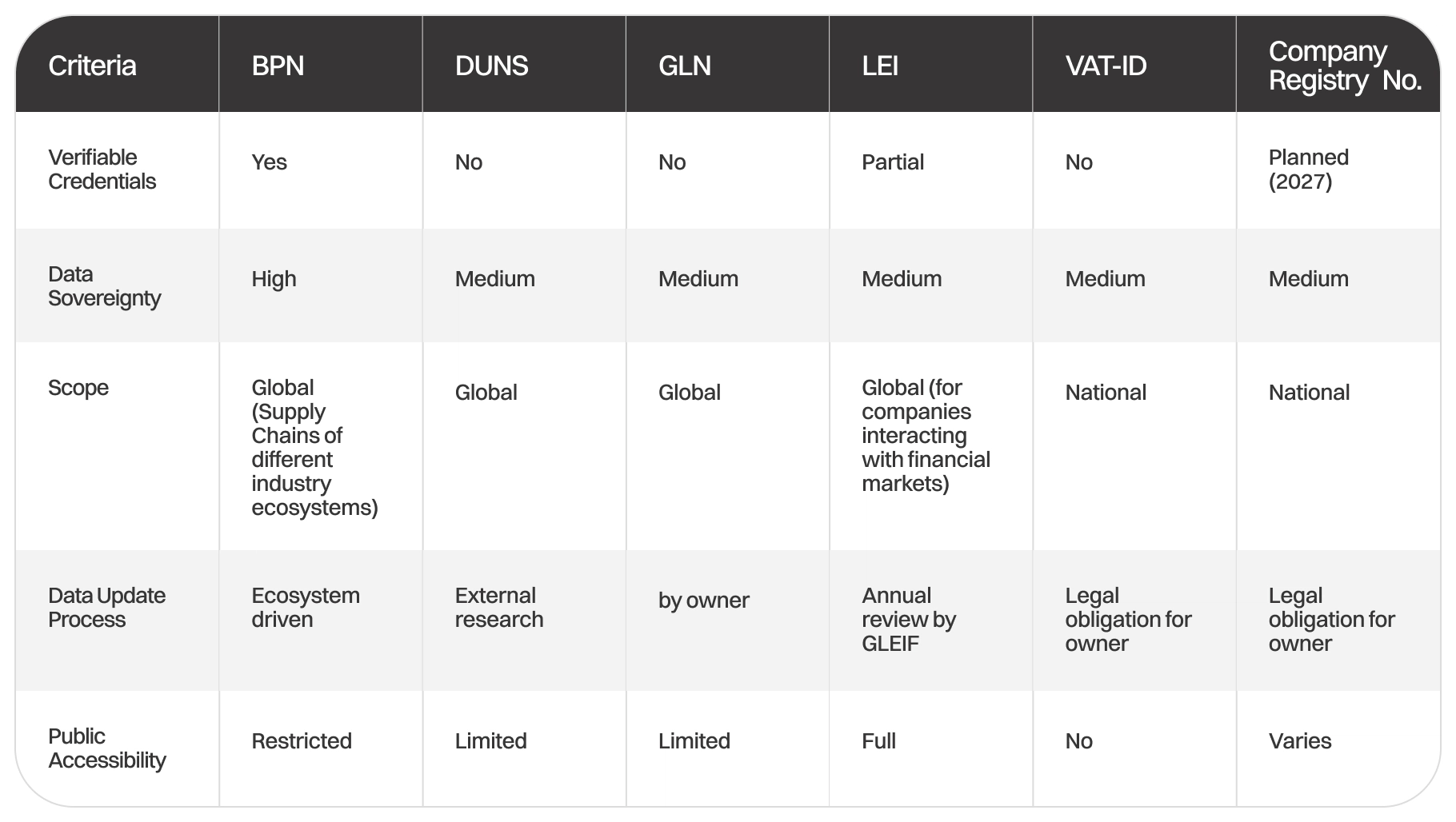
You might wonder: with identifiers like DUNS, GLN, LEI, VAT-ID, and company registry numbers already in place, why introduce a new one? The answer lies in the unique challenges of global, interoperable, and sovereign data exchange in modern value chains. The Data Sharing Community (DSC), a working group of Cofinity-X Golden Record customers, compared some typical identifiers used in automotive data management and explains, why only the BPN truly meets the demands of a decentralized, trusted dataspace like Catena-X.
Why you need a BPN to join Catena-X
Joining Catena-X without a BPN is like trying to enter a country without a passport. The BPN ensures that every participant in the network is uniquely identifiable, enabling trusted interactions. To become part of Catena-X, every participant has to register with Cofinity-X, the technical operator and gateway to Catena-X. After reviewing your application, Cofinity-X assigns you a BPN. This process guarantees that your identity is verified, secure, and interoperable within the Catena-X ecosystem.
Your BPN then acts as your “phone number” within the ecosystem. You can share your BPN with partners via common communication channels (e.g., email). Your partners use the BPN to identify your Dataspace Connector within the network and grant specifically you access to datasets - or vice versa. Through this mechanism, the BPN supports security and ensures data sovereignty, as the data owner alone decides with whom to share his digital gold.
Other common identifiers
- DUNS (Data Universal Numbering System): DUNS is provided by Dun & Bradstreet to track and provide information on businesses and credit ratings.
- GLN (Global Location Number): GLN provided by GS1 can be used by companies to specify physical, digital, or functional locations.
- LEI (Legal Entity Identifier): LEI is a unique 20-character code by GLEIF used to identify legally distinct entities that engage in financial transactions globally.
- VAT-ID: A VAT-ID is a unique identifier assigned to businesses and entities for tracking and reporting value-added tax within a country's tax system.
- Company registry number: is a unique identification number assigned to a business when it is officially registered with a national or regional company registry authority.
VAT-ID and company registry numbers are local by nature, structured differently across jurisdictions, and lack global uniqueness. Other identifiers also fall short in key areas that Catena-X requires. So what makes the BPN different?
What makes the BPN unique
The DSC’s comparison highlights several key advantages of the BPN:
- Verifiable credentials for dataspaces
The BPN supports verifiable credentials that are compliant with the standards and guidelines of the World Wide Web Consortium (W3C). These credentials are essential for secure and legally defined data exchange in decentralized networks. - High data sovereignty
The BPN allows data owners to control the distribution of and access rights on their data. This is a major difference compared to commercial identifiers, which are managed by third-party data brokers. - Global scalability
The BPN is designed for global use, especially in automotive and industrial value chains. - Tailored for supply chain structures
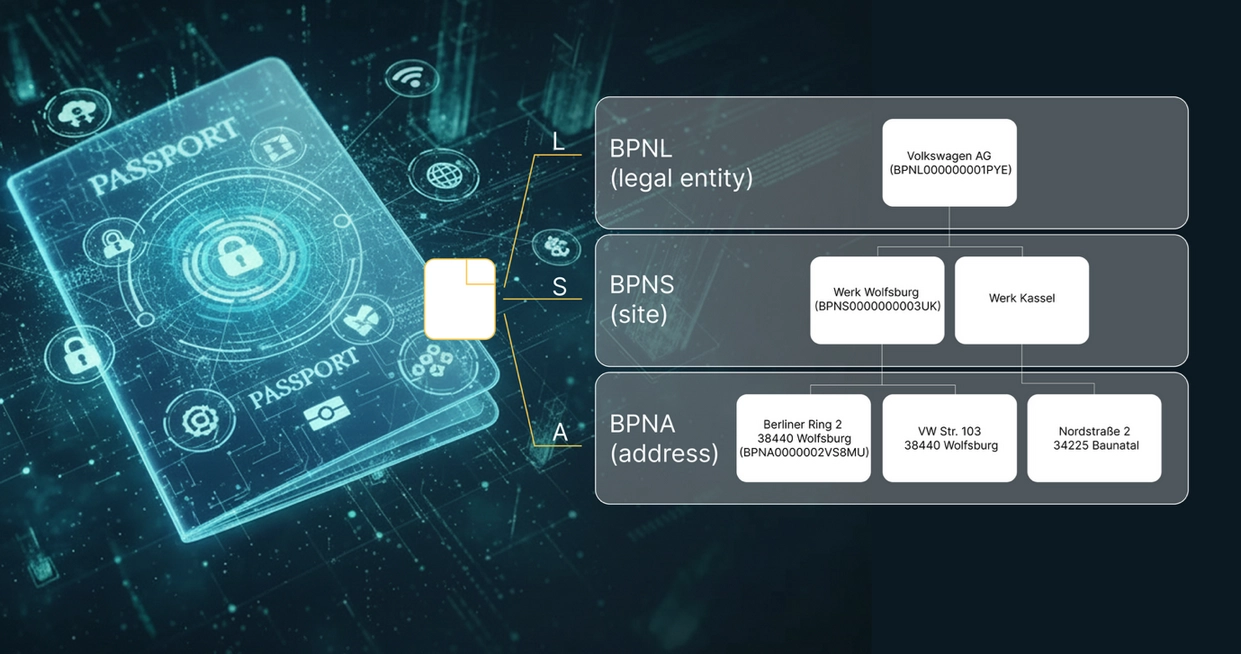
The BPN system provides a solution to not only identify companies, but also allowing structure business partner data in greater detail. The BPN structure includes:- BPN-L for legal entities
- BPN-S for sites
- BPN-A for additional addresses
This structure supports complex value chain mapping and traceability.
How does the BPN compare to other identifiers
The Role of the Data Sharing Community
This comparison and the development of the BPN are the result of collaborative work by the Data Sharing Community (DSC). The DSC is a working group of clients already operating with the BPN-system and the Business Partner data management product Golden Record by Cofinity-X to exchange experience and finetune the operating processes. The DSC is organized by Cofinity-X and open for clients with BPDM contracts. With the support of the DSC, the Catena-X e.V, was recently able to achieve an ISO/SEC-Certification for the BPN.
How to get your BPN
Participating in Catena-X is straightforward. The process always starts with the registration with Cofinity-X.
- Register with Cofinity-X and enter your company’s official name, address, and VAT-ID.
- Cofinity-X validates your data together with an external institution.
- Receive your BPN via email along with instructions to access the Catena-X portal and manage your digital identity.
This process ensures that every participant is verified and trustworthy, enabling seamless integration into the network.
Join the future of automotive collaboration
The BPN is more than a technical requirement. It is a strategic asset for companies looking to thrive in the Catena-X ecosystem and benefit from secure, sovereign, and scalable data exchange.
If you are in the automotive sector, getting your BPN is the first step toward digital transformation. Register now and become part of a network where trust, transparency, and collaboration drive innovation.
Learn more:
- Explore the Golden Record
- Business Partner Data Management
- Why data sovereignty is crucial and how it is enforced by dataspaces
Disclaimer: All trademarks and names mentioned are the property of their respective owners and are used solely for descriptive purposes